This site is shared with project stakeholders for discussion purposes. Enter the access code to continue.
Need access? Contact [email protected]
Ten places that turned a corridor into a neighborhood - and the patterns they share.
We studied ten of the most-cited local economic development turnarounds of the last three decades - from near-zero-cost street policy to billion-dollar innovation districts - to find what actually separates the places that worked from the ones that disappointed. The answer is not how much was spent. It is the order in which it was spent.
The most successful districts spent cheap-and-fast first, used early wins to prove demand and de-risk, then drew the heavy capital that built the permanent place.
Led with activation, policy, and residents. Stood up a patient delivery vehicle that outlasted any single administration. Treated identity and authenticity as underwriting, and built anti-displacement in from day one.
Over-indexed on a single big object - one museum, one tower, one mega-project - or forgot to protect the residents and small businesses who give a place its value. Scale without sequence stalls.
Ordered by the capital required to start. The pattern that matters: the cheapest interventions often carry the highest return on the dollar, and they are what make the expensive interventions financeable later.
Active-frontage policy paired with residential repopulation. The city legislated street life into being, then let it compound.
Laneways went from 8% to 92% active (1994-2004); a measured +10% in walking connectivity has been associated with roughly +$2.1B/yr to the local economy.
Low-cost, temporary demonstrations - paint, planters, pop-ups - that test an idea in public before permanent capital is committed.
Pedestrianization pilots have produced documented retail-sales lifts that justified the permanent build.
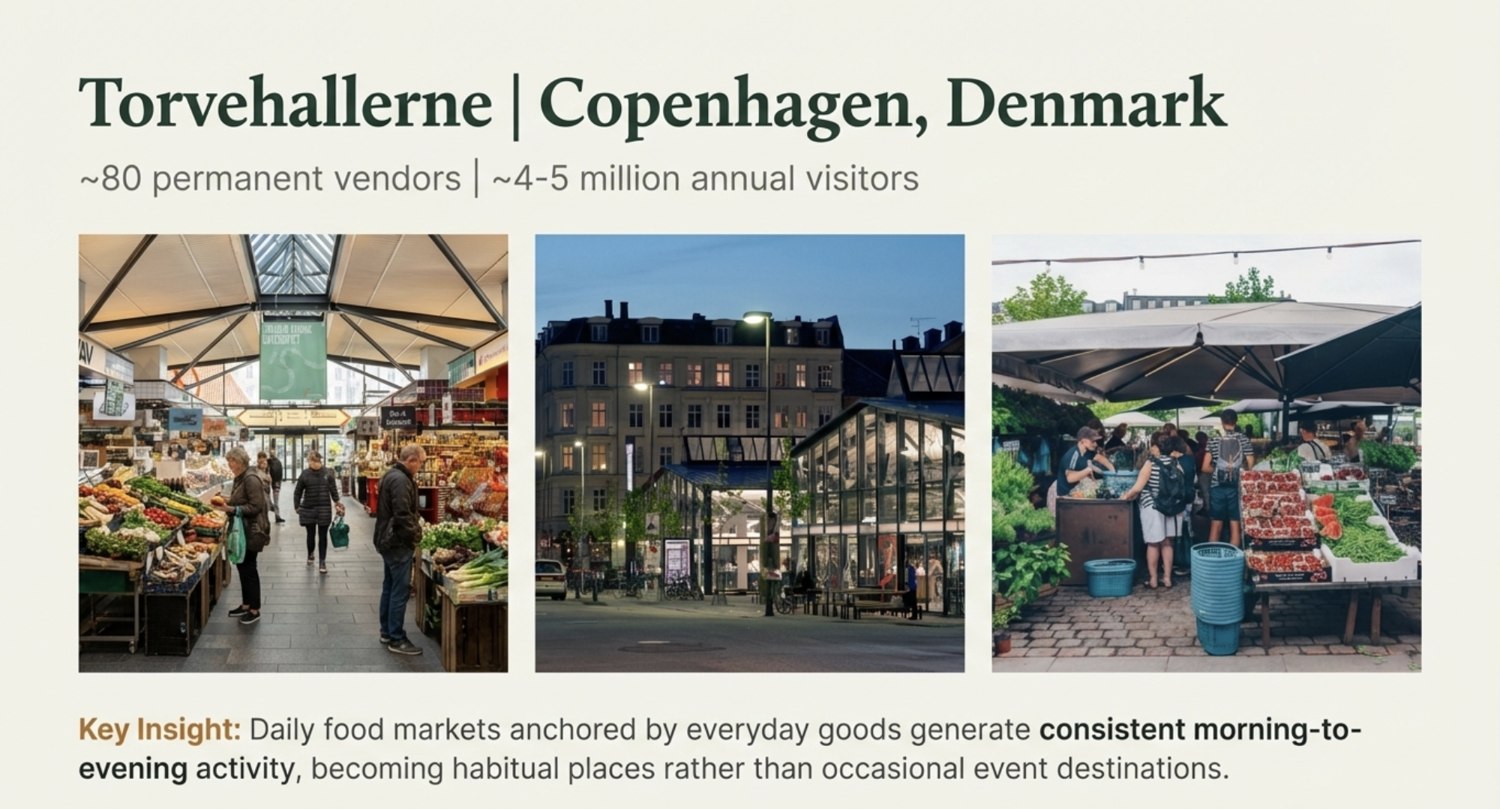
A permanent market hall and a container food park - one an identity anchor, the other a low-rent incubator for new operators.
A nonprofit delivery vehicle (River City Company) led a public riverfront investment that pulled private capital in behind it.
River City Company leveraged $12M of seed capital into roughly $1.5B of private investment.
Equity-first investment - Metrocable transit and library parks placed in the hardest-hit neighborhoods first.
Caution: long-term maintenance and displacement pressures must be planned for.
A zoning-led innovation district that converted industrial land to a dense jobs cluster.
Caution: fewer than 25K jobs were net-new; gentrification and heritage concerns followed.
A North American model for streetcar-led, brownfield-to-neighborhood transformation delivered by a consortium.
The connective tissue - the method that ties culture to real estate and speeds approvals and lease-up.
The residential repopulation lever - put rooftops over downtown first, and the shops follow the residents.
Strip away geography and budget and the successful cases run on the same ten moves. None is exotic. The discipline is doing all ten, in order, and not skipping the cheap ones.
A magnet use plus programmed, daily street life around it.
Philanthropy and public money de-risk the early moves; private capital follows the proof.
A nonprofit, agency, or consortium that owns the outcome - not city hall alone.
A density of residents is the demand engine that everything else depends on.
Small tenancies, competitive rents, room to experiment and fail cheaply.
Count pedestrians; let demonstrations earn their way into permanence.
Walkability and transit are what actually drive land value.
Low-barrier space seeds local ownership and authentic identity.
Culture and authenticity are not decoration - they are underwriting.
Anti-displacement is built in from day one, never bolted on later.
The ten patterns mapped against seven of the places. Read down a column to judge how complete a place's playbook was; read across a row to see how universal a pattern is. The lesson is in the totals: the repopulation-and-activation stories (Melbourne, Pearl) express nearly every pattern, while the single-flagship case (Bilbao) and the zoning-only case (22@) visibly skip several - which is exactly why their outcomes carried cautions.
| Pattern | Melbourne | Copenhagen | Chattanooga | Medellín | Bilbao | 22@ Barcelona | Pearl District |
|---|---|---|---|---|---|---|---|
| Anchor + Activation | ● | ● | ● | ● | ● | ◐ | ● |
| Patient Blended Capital | ◐ | ◐ | ● | ● | ● | ● | ● |
| Dedicated Delivery Vehicle | ● | ◐ | ● | ● | ● | ● | ● |
| Residents First | ● | ◐ | ◐ | ● | ○ | ◐ | ● |
| Active Ground Floors | ● | ● | ◐ | ◐ | ○ | ◐ | ● |
| Measure & Iterate | ● | ◐ | ◐ | ● | ◐ | ◐ | ◐ |
| Connectivity Unlocks Value | ● | ● | ● | ● | ◐ | ● | ● |
| Incubate Small Business | ● | ● | ◐ | ◐ | ○ | ● | ◐ |
| Identity as Asset | ● | ● | ● | ● | ● | ◐ | ● |
| Equity by Design | ◐ | ◐ | ◐ | ● | ○ | ○ | ● |
| Patterns fully expressed | 8 | 5 | 5 | 8 | 4 | 4 | 8 |
Assessment is the authors' reading of the cited cases, meant to show the shape of each playbook rather than to score the places precisely.
Ranked by return on the dollar, the order is almost the inverse of cost. The cheapest tools move a place the most per dollar - and they are precisely what makes the expensive tools financeable.
The same logic, expressed as a delivery order. Each stage de-risks the next, so patient and public capital at the front end is what unlocks institutional capital at the back end.
Tactical activation and programming prove demand. Near-zero or philanthropic / public capital.
A market hall and flexible space establish identity and a tenant pipeline. Modest catalytic capital.
Residential density becomes the demand engine. Institutional joint-venture capital, with affordability locked early.
Full retail, civic, and green program. Permanent value, underwritten on a place that already works.
The catalytic public or patient capital that started each place, against the value it went on to unlock. The figures are nominal, drawn from the cited literature across different years and currencies, so they are directional, not directly comparable - but the pattern is unmistakable: small, well-placed catalytic capital pulls in many multiples of private value.
| Place | Catalytic / patient investment | Value & outcomes created | Leverage / note |
|---|---|---|---|
| Melbourne · Postcode 3000 | Near-zero - planning & zoning reform, no grants | CBD homes ~1,000 → ~10,000 in a decade; inner-city population now 116,000+ | Policy, not capital |
| Copenhagen · Torvehallerne | Private market-hall capex | 60,000+ weekly visitors; a permanent identity anchor and small-business incubator | Identity + tenant pipeline |
| Chattanooga | ~$120M public (21st Century Waterfront, 2005) | ~$3.8B of central-city development since the 1992 Aquarium | ~$12M seed → ~$1.5B private |
| Medellín | Public Metrocable + library parks + public space | Homicide down ~75% in intervention areas; rising land value and public trust | Social ROI |
| Bilbao · Guggenheim | ~$228M total project (~$100M building) | ~€500M of activity and ~€100M of taxes in the first 3 years; €4.3B GDP and €659M tax by 2016 | Repaid the build in ~3-6 yrs |
| 22@ Barcelona | >€180M public infrastructure | 4,300+ companies and ~93,000 jobs on former industrial land | Jobs (not all net-new) |
| Pearl District · Portland | ~$100M streetcar (2001) | $3.5B+ private investment within three blocks (1997-2008); $5B+ along the line | ~35× locally |
Sources below. Nominal figures across multiple years and currencies; shown to convey order of magnitude.
The single most important expectation to set. None of these places turned overnight. Early, visible wins tend to land in the first one to three years - which is what the cheap activation layer buys - but full maturity is a ten-to-twenty-year arc. Patience, and a vehicle built to outlast it, is the precondition.
| Place | Kicked off | First visible wins | Toward maturity | Full arc |
|---|---|---|---|---|
| Melbourne · Postcode 3000 | 1992 (policy) | Homes & laneway life within 2-5 yrs | 3,000-home goal met by 2000; laneways 92% active by 2004 | ~10-15 yrs |
| Copenhagen · Torvehallerne | Opened 2011 | A draw from opening day | City landmark within a few years; Reffen added 2018 | ~10 yrs idea→icon |
| Chattanooga | 1984 / Aquarium 1992 | Aquarium drew visitors immediately | 21st Century Waterfront 2002-05; momentum sustained 20+ yrs | 20+ yrs |
| Medellín | 2004 | Ridership & safety gains within 2-3 yrs | Library parks by 2007; measured turnaround by 2012 | ~8-10 yrs |
| Bilbao · Guggenheim | Agreed 1991 | Tourism spike on the 1997 opening | Building cost repaid within ~3-6 yrs | ~6-10 yrs to payback |
| 22@ Barcelona | 2000 | Firms arriving within a few years | 4,300 firms / 93k jobs accrued over two decades | 20-25 yrs |
| Pearl District · Portland | Late 1990s / streetcar 2001 | Lofts & galleries within 3-5 yrs | $3.5B by 2008; still maturing | ~10-15 yrs |
The patterns only fire when the ground conditions support them. Where these were missing, even well-funded efforts stalled.
Early, visible wins rebuild the public confidence that makes everything later possible.
Delegated authority and ring-fenced funds, so the vehicle can act without re-litigating every step.
A delivery vehicle that outlasts any single political administration.
Jobs that actually pay the rents the pro forma assumes.
Incubation and shared equity, so value created stays in the community.
Affordability locked early, before land values climb out of reach.
River City Company in Chattanooga. An economic-development unit in Medellín. A design-led consortium in Portland. The single most consistent feature of the successful cases is a patient, dedicated vehicle that carried the place from first activation through long-term operation.
Pre-development intelligence and feasibility - the front-end, de-risking work the pattern requires before private capital will move.
Development and long-term operation with institutional partners - the patient owner-operator that holds the place through every stage of the sequence.
Melbourne / Postcode 3000: The Urbanist; City of Melbourne / Postcode 3000; Global Designing Cities; Monocle.
Bilbao: Guggenheim Bilbao economic-impact studies; The Art Newspaper.
Medellín: World Resources Institute; ArchDaily; Architect Magazine.
22@ Barcelona: Atlas of Urban Tech; Barcelona City Council.
Chattanooga: River City Company; Chattanooga Times Free Press; Brookings Bass Center.
Pearl District: Energy Innovation case study; ZGF; NW Examiner.
Copenhagen: VisitCopenhagen; Copenhagen Tourism.
Creative Placemaking / Tactical Urbanism: NEA; ULI (2020); Urban Institute / ArtPlace; LISC; World Bank.
Planning-level synthesis for discussion. Figures are drawn from the cited third-party literature and describe the precedent cases, not any specific project. Case photographs are hosted on Wikimedia Commons under their respective Creative Commons or public-domain licenses; click any image for its source and license.
See how this sequence shapes the district's interim strategy on the Activation Plan, or learn more about Now City at nowcity.co.