How We Build Regenerative Neighborhoods
A practical framework for designing and developing places that balance economic, social, and ecological health, from block to region.
Guiding Principles
Design for Life to Thrive
Real estate development has to evolve — just as architecture and sustainability have. At Now City, we see design as a framework for regeneration, not decoration. Our approach is rooted in systems thinking and biomimicry: learning from how living systems grow, adapt, and give back more than they take.
We design and develop neighborhoods that restore natural systems, strengthen local economies, and make everyday life healthier, more affordable, and more connected.
Flow Before Form
Design around the movement of people, energy, water, and materials.
Community as Infrastructure
Social connection is as vital as physical systems.
Adaptive by Design
Plan for change; build for resilience.
The Process
From Vision to Groundbreaking
As full stack real estate developers and advisors we collaborate with landowners, developers, capital partners, design teams, public agencies, and communities to transform underutilized properties into vibrant districts that balance community, ecology, and capital.
1. Vision & Feasibility
2. Design & Entitlements
3. Capital Formation
4. Construction & Stewardship
Why It Matters
Regeneration at Every Scale
When neighborhoods are designed to flow — economically, socially, ecologically — everyone benefits.
From lower carbon footprints and stronger local economies to deeper social belonging, Now City’s approach turns sustainability into a shared, lived experience.
The Now City Stack
Technology in Service of People and Place
Technology at Now City isn’t about gadgets or smart sensors for their own sake. It’s about using information to make daily life easier, neighborhoods more efficient and resilient, and decisions more transparent.
The Now City Stack brings together tools for planning, design, operations, and community engagement — helping residents, partners, and cities see how their neighborhood is performing and improving over time.
At its core is NowCity.AI, an adaptive intelligence platform that learns from each project. It helps us:
-
Track how energy, water, and mobility systems perform.
-
Measure health, equity, and wellbeing outcomes.
-
Guide better decisions for residents, investors, and local governments.
It’s technology in service of trust, giving everyone the ability to understand, participate in, and benefit from the neighborhoods they help create.
The Question That Drive Us
Neighborhood In A Box
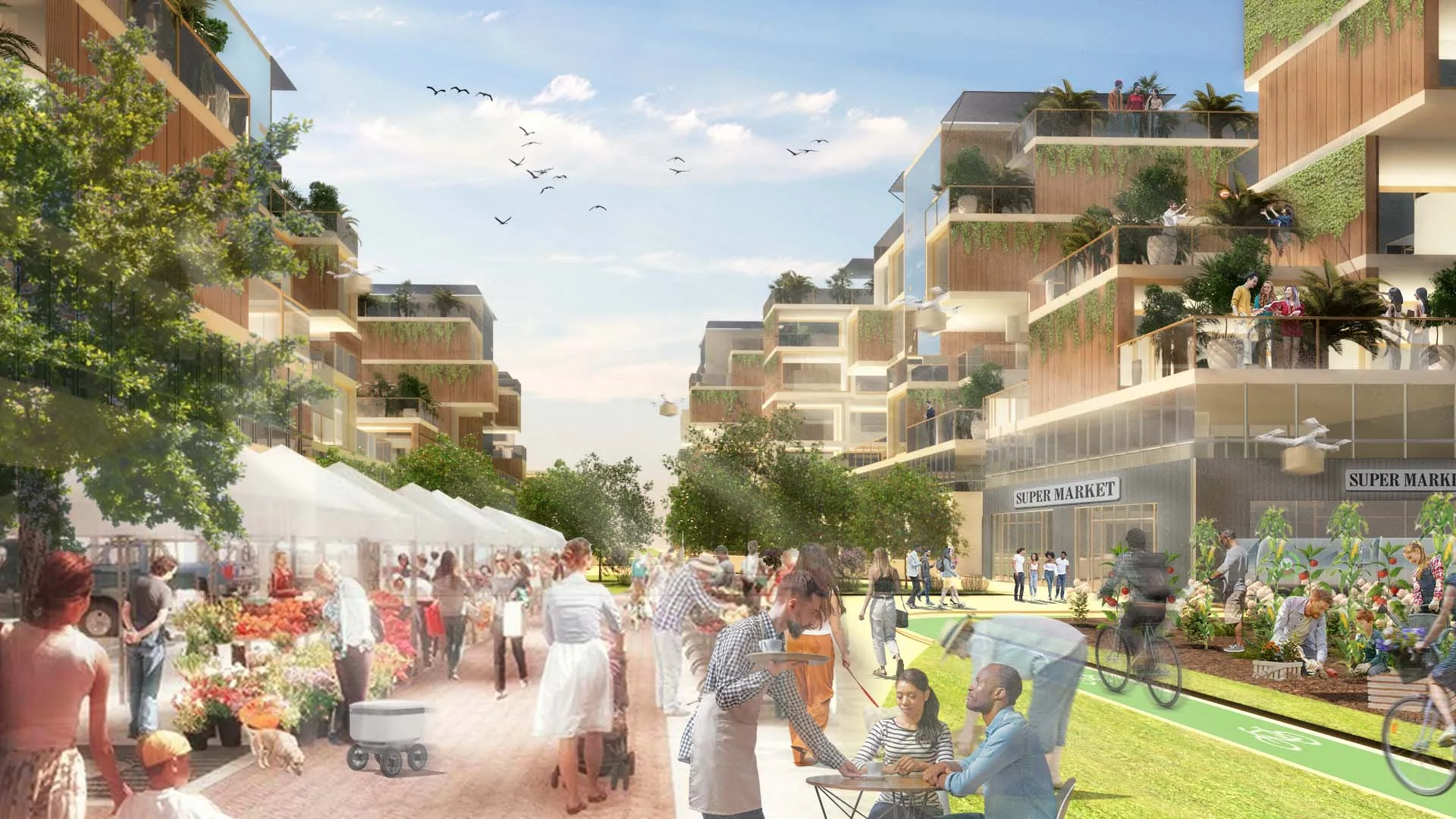
What if we think about a neighborhood like a product designed to help people and ecosystems thrive? And improve over time? The neighborhood scale (1000-10,000 people) is a sweet spot for enabling next gen urban design, walkability, community, and economic development, along with reduced construction costs and efficiency gains in green infrastructure and building systems.
Spacer (hidden)
Complete Communities
Walkability + Mobility: Prioritizing pedestrian pathways and cycling over car traffic, creates safe, accessible, and enjoyable routes that connect people not just to places but to each other. Imagine safe easy access to multi-modal transport, ensuring that even when you need to venture beyond, your journey is smooth and sustainable.
District Scale Green Infrastructure
Imagine #infrastructure-as-a-service
Advanced Construction
Healthy Sustainable Materials…Imagine selecting materials based on their lifecycle sustainability, sourcing locally wherever possible to reduce carbon footprint and support innovations in bio-based materials and recycled content that contribute to a #circular-economy.
Next Gen Management
Neighborhood Operating System… Imagine all that as a Neighborhood Operating System in the hands of a dedicated team of smart, empathetic property and community managers helping people thrive and build community.
Zero-Waste Living
Urban Agriculture
Innovative Finance
Funding remains one of the biggest challenges in developing innovative real estate solutions. Real estate development is generally dependent on wealthy and powerful local and international investors focused on profit rather than people and planet.
Can Now City find a new model of co-ownership and co-development within the neighborhood?
Now City is part of a growing movement toward balancing the needs people, planet and profit with new financial models.
Diving Deeper
Now City Design Guidelines
In service of our goal to develop a scalable solution to climate change, global housing crises, and social inequity, we have developed a set of design guidelines to streamline the process of adapting Now City Neighborhoods to different sites with unique geographic, climate, and social attributes.
The following 10 guiding principles enable us to respond to the needs of local communities and ecosystems while delivering resilient, regenerative, and hedonistically sustainable (delightful and green!) neighborhoods. We would love your feedback and invite you to visit our public Guidelines Collaboration Trello board where you can vote and comment on each of these guidelines.
Place Based

Design neighborhoods to positively impact local communities and ecosystems.
Lack of site selection considerations can result in the destruction of wildlife habitats, disruption of water sources, deforestation, and increase long term costs. By choosing the development sites responsibly from the beginning can help avoid many long term and future adverse circumstances.
How can Now City choose and develop our sites to protect and integrate our built and natural environments?
Any Now City site will go through an extensive site analysis phase determining our impact locally. With site selection we aim for locations that can promote resiliency in place.
Compact

Design walkable neighborhoods with more of what we need close to help us reduce our carbon footprint and improve living conditions.
As metropolitan populations increased over the last century, typical urban development in the United States has been defined through urban sprawl. Sprawl is most often characterized by single-family residential housing, the separation of residential neighborhoods from retail and commercial land uses, and the increased reliance on the private automobile for transportation. This style of development has been correlated with increased energy use, pollution, and traffic congestion, a decline in community cohesion, as well as rapid use of ecological assets.
How can Now City be designed and developed as dense, compact, and complete neighborhood units that achieve the principles of a fifteen minute city?
Compact development to us means not only making your daily needs attainable but connected better than ever. At now city we aim to build density that delivers.
People Centric

Design for walkability and micro-mobility to make neighborhoods safer, quieter, & cleaner.
Car centric urban planning is a fragile system that adversely impacts health, climate, equity, and safety. The current reliance on automobiles resulted in overbearing roads and highways cutting through our cities’ urban fabric. Car centric roads create an unnecessary distance between services and continuously fuel urban sprawl. These adverse effects create increasingly large carbon footprint on our planet over time.
How can we transition away from car centric planning through the integration of alternative mobility modes that promote a healthier and safer living environment?
Our team aims to seamlessly integrate multi mode transportation while returning the focus to the pedestrian. Hand in hand with our compact development, we make getting around easy and enjoyable.
Healthy Environment

Design neighborhoods with easy access to high quality greenspace, community, clean air, clean water, and healthy food to promote happiness, wellbeing, and sustainability.
Current urban spaces do not reflect and adapt to recent findings on the impact of design on health and wellness. Studies have found that people who spend as little as two hours in nature each week report higher levels of wellbeing compared to those that don’t. These boosts to mental and physical health span across socioeconomic statuses, neighborhoods and genders. Studies have also proven that regularly visiting parks can lower depression, improve sleep, reduce stress and bring about greater levels of happiness.
Access to high quality green spaces, a compact and walkable environment and integration of nature in every design is at the core of what make’s us Now City. These features help create not only healthy, but delightful spaces.
Decentralized Systems

Design neighborhoods to be self sustaining to promote resilience, increase value, and reduce operating costs over the long term.
Today’s urban environments depend on large centralized systems for most essential and non-essential resources. Not only does this increase the load on the individual system, but also increases users dependency, logistical costs, and unsustainable practice chains leading to bigger climate change problems. Additionally in the event of a climate emergency, or hazard like Covid 19, where particular areas are cut off, the negative side of these dependencies are laid bare and users are left scuttling to satisfy basic needs.
Could we work towards creating a community that could sustain itself through sustainable practices (as a way of building resilience) in a regular and emergency situation?
Now City put’s a focus on neighborhood resiliency by redesigning the systems we rely on everyday. Bringing food production on site, net positive energy production, and access to essential services all lay the groundwork for a self sufficient and resilient community.
Circular Economy Mindset

Make it easier to reduce, reuse, and recycle to reduce negative impacts and the cost of living in the long term.
Linear use of resources jeopardizes our ecosystem and economy through high consumption of limited natural resources, high emission of toxins and waste, and high fluctuation in prices of raw materials. These wastes continue to negatively impact our environment and economy.
How can we reduce our ecological footprint and regenerate our lost ecosystems and resources through a circular economy?
Now City is intent on regeneration, keeping our system in a closed loop that circulates valuable resources. Reducing and recycling is just a start, we also strive for low to zero waste in many of our systems.
Ecologically Rooted

Design with an ecological and empathetic mindset to positively impact wellbeing and the environment.
Many developers today focus on creating functioning road networks, with smart infrastructure and a world class built environment. Each creator has their own goal for profits, built area, quality environments etc, but one of the aspects that is often at the bottom of the checklist is ecology.
What if we designed to not just conserve the existing ecology, but develop and improve ecological health of the neighborhood?
The a goal of living not only within the natural realm, but with it central to Now City developments. By prioritizing live and breathing systems we generate new ideas to integrate ecology into everyday life.
Technology Driven Flexible Development

Use advanced tools to design flexible & re-configurable spaces and places to make it easier and cheaper to adapt to changing conditions.
Traditional development and construction have proven a lack of flexibility. The built environment often has no give and take for future inhabitants, user preference or future feedback. Cities and neighborhoods are built with cookie cutter living units and infrastructure.
How can we design and construct with flexibility so that our cities and neighborhoods can evolve and improve rather than degrade over time?
We start at the root of our construction with flexible building strategies, we can continue to transform and improve overtime creating a more resilient place.
Successful Feedback Loops

Include community input at all stages of development and operation to reduce risk, improve quality, and increase value. It’s better to know what people need and want and build that instead of guessing and building the wrong thing.
Traditional development and construction lack participation and feedback from the users or the public. Developments and construction often follows a top down methodology where the end users are not part of the process.
How can we integrate user participation and feedback loops into the whole development process so that we can mitigate risk and build responsibility for the people?
By including the users through the development process at every step, Now City aims to mitigate post construction risk and build developments cherished and enjoyed by everyone
Innovative Finance

Use innovative models to finance green living, create social equity and provide attainability of housing for all.
Funding remains one of the biggest challenges in developing innovative real estate solutions. Real estate development is generally dependent on wealthy and powerful local and international investors focused on profit rather than people and planet.
Can Now City find a new model of co-ownership and co-development within the neighborhood?
Now City is part of a growing movement toward balancing the needs people, planet and profit with new financial models. Join us to be early to learn of opportunities to participate in the development of Now City.
A Scalable Blueprint
If we let ourselves collectively rise to the occasion of building the 25 million homes that America needs by 2050, we can imagine walkable green neighborhoods as the building blocks of cities that are regenerative, resilient, and equitable.
“Cities are a network of neighborhoods.” – Kent Larson, MIT City Science
A Global Community
Let’s Collaborate
While our projects begin on the West Coast, our framework is designed to be adaptable anywhere in the world, from small towns to major cities. We believe regeneration is local by nature, but universal in value.